 The
Music Room The
Music Room |
To
Brebru.com |
To
Band Pages |
 The grandchild
of Jewish-Russian immigrants, Dylan was born Robert Allen Zimmerman, on May
24, 1941, in Duluth, Minnesota, where his father, Abe, worked for the Standard
Oil Company. In 1947, the Zimmerman family moved to the small town of Hibbing,
where an unexceptional childhood did little to hint at the brilliance to come.
Robert started writing poems around the age of ten, and taught himself rudimentary
piano and guitar in his early teens.
The grandchild
of Jewish-Russian immigrants, Dylan was born Robert Allen Zimmerman, on May
24, 1941, in Duluth, Minnesota, where his father, Abe, worked for the Standard
Oil Company. In 1947, the Zimmerman family moved to the small town of Hibbing,
where an unexceptional childhood did little to hint at the brilliance to come.
Robert started writing poems around the age of ten, and taught himself rudimentary
piano and guitar in his early teens.
Falling under the spell of Elvis Presley, Jerry Lee Lewis, and other early
rock stars,he started forming his own bands, including the Golden Chords and
Elston Gunn and His Rock Boppers. According to the 1959 Hibbing high school
yearbook, his goal was "to join Little Richard." The young Zimmerman
left Hibbing for Minneapolis and the University of Minnesota in the fall of
1959. The sights and sounds of the big city opened new vistas for him, and
he began to trace contemporary rock and roll back to its roots, listening
to the work of country, rock, and folk pioneers like Hank Williams, Robert
Johnson, and Woody Guthrie.
The following year, he dropped out of college and went to New York with two
things on his mind: to become a part of Greenwich Village's burgeoning folk-music
scene, and to meet Guthrie, who was hospitalized in New Jersey with a rare,
hereditary disease of the nervous system. He succeeded on both counts, becoming
a fixture in the Village's folk clubs and coffee houses and at Guthrie's hospital
bedside, where he would perform the folk legend's own songs for an audience
of one. Spending all of his spare time in the company of other musicians,
Dylan amazed them with his ability to learn songs perfectly after hearing
them only once. He also began writing songs at a remarkable pace, including
a tribute to his hero entitled "Song to Woody."
Indeed, his interest in music had become so intense that he rarely found the
time to go to class. He began to perform solo at local nightspots like the
Ten O'Clock Scholar cafe and St. Paul's Purple Onion Pizza Parlor, honing
his guitar and harmonica work and developing the expressive nasal voice that
would become the nucleus of his trademark sound. It was around this time,
too, that he adopted the stage name Bob Dylan, presumably in honor of the
late Welsh poet Dylan Thomas, though this is an origin he has continued to
deny throughout his career.
In the fall of 1961, Dylan's legend began to spread beyond folk circles and
into the world at large after critic Robert Shelton saw him perform at Gerde's
Folk City and raved in the New York Times that he was "bursting at the
seams with talent." A month later, Columbia Records executive John Hammond
signed Dylan to a recording contract, and the young singer songwriter began
selecting material for his eponymous debut album. Not yet fully confident
in his own songwriting abilities, he cut only two original numbers, rounding
out the collection with traditional folk tunes and songs by blues singers
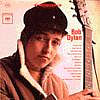
like Blind Lemon Jefferson and Bukka White. The result (released early in
1962) was an often haunting, death-obsessed record that, culminating in Dylan's
gravel-voiced reading of "See That My Grave Is Kept Clean," sounded
as much like the work of an aging black blues man as a twenty-one-year-old
Jewish folksinger from Minnesota.
Promising as that first album was, it didn't prepare anyone for the masterpiece
that came next. The Freewheelin' Bob Dylan, released in 1963, contained two
of the sixties' most durable folk anthems, "Blowin' in the Wind"
and "A Hard Rain's A-Gonna Fall," the breathtaking ballads "Girl
From the North Country" and "Don't Think Twice, It's All Right,"
and nine other originals that marked the emergence of the most distinctive
and poetic voice in the history of American popular music. Cementing his reputation
was Peter, Paul, and Mary's folksy cover of "Blowin' in the Wind,"
which went to No. 2 on the pop singles chart.
Dylan's next album, The Times They Are A-Changin', provided more of the same:
the title cut and "The Lonesome Death of Hattie Carroll" were the
standout protest songs, while "Boots of Spanish Leather" was his
saddest and most graceful love song so far. At the same time, Dylan seemed
to be tiring of his position at the forefront of the protest movement: in
"Restless Farewell," the record's last song, he concluded that he'd
"bid farewell and not give a damn." Sure enough, his next album,
pointedly titled Another Side of Bob Dylan, was his most introspective and
least topical to date, and its finale, "It Ain't Me Babe," was an
even more explicit goodbye to the folk movement he had helped reinvigorate.
The most revealing song on Another Side was "Ballad in Plain D,"
which painted a harsh, one-sided, blow-by-blow picture of Dylan's breakup
with his longtime girlfriend Suze Rotolo, who can be seen on his arm in happier
days on the Freewheelin' album cover. (More than twenty years later, Dylan
said this was the one song in his catalogue that he wished he hadn't released.)
Shortly after his split with Rotolo, he became involved with the world's most
famous folk diva, Joan Baez. The relationship proved beneficial for them both,
as Baez raided Dylan's unreleased material for her albums and introduced him
to thousands of fans at her concerts.
At the same time, Dylan was itching to move beyond the acoustic musical constraints
the folk movement imposed. Early in 1965, he went into the studio with a nine
piece band and recorded Bringing It All Back Home, a half-electric, half-acoustic
album of complex, incisive, biting songs like "Subterranean Homesick
Blues" (featuring the trademark line, "You don't need a weatherman
to know which way the wind blows"), "Mr. Tambourine Man," and
"It's All Over Now, Baby Blue. A week after Dylan cut Bringing It All
Back Home, the Byrds electrified his acoustic "Tambourine Man,"
and by the time it reached the top of the charts the term "folk-rock"
had become part of the contemporary lexicon.
 Dylan's
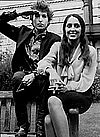
own transition from folk troubadour to rock bard was not quite so smooth:
debuting his new material with the Paul Butterfield Blues Band at the 1965
Newport Folk Festival, he was famously booed off the stage. Such resistance
notwithstanding, Dylan's fame had long since eclipsed Baez's, and their relationship
was starting to crumble. (D.A. Pennebaker's documentary Don't Look Back was
filmed during this period, and it clearly shows the tension between Dylan
and Baez.) He had begun to see Sara Lowndes, a friend of his manager Albert
Grossman's wife, and by the end of the year would marry her. In the meantime,
he recorded and released the album Highway 61 Revisited, which contained the
monumental single "Like a Rolling Stone." Clocking in at more than
six minutes, it was the longest, angriest song ever released on a 45, and
it reached No. 2 on the Billboard singles chart.
Dylan's
own transition from folk troubadour to rock bard was not quite so smooth:
debuting his new material with the Paul Butterfield Blues Band at the 1965
Newport Folk Festival, he was famously booed off the stage. Such resistance
notwithstanding, Dylan's fame had long since eclipsed Baez's, and their relationship
was starting to crumble. (D.A. Pennebaker's documentary Don't Look Back was
filmed during this period, and it clearly shows the tension between Dylan
and Baez.) He had begun to see Sara Lowndes, a friend of his manager Albert
Grossman's wife, and by the end of the year would marry her. In the meantime,
he recorded and released the album Highway 61 Revisited, which contained the
monumental single "Like a Rolling Stone." Clocking in at more than
six minutes, it was the longest, angriest song ever released on a 45, and
it reached No. 2 on the Billboard singles chart.
Next up was Blonde on Blonde, a two-record set recorded in Nashville in early
1966, which took the stream-of-consciousness lyrics and edgy rock sounds of
Highway 61 Revisited to the next level of artistry. From the raucous party
rock of "Rainy Day Women #12 & 35" to the rambling, hallucinogenic
folk 'n' blues of "Stuck Inside of Mobile With the Memphis Blues Again"
to the poignant, apocalyptic balladry of "Visions of Johanna" and
"Sad Eyed Lady of the Lowlands," Blonde on Blonde took rock and
roll to places no one else had even dreamed of. A tour of England with the
Hawks (who would later change their name to the Band) produced music that
was even wilder and more astonishing, though many of Dylan's old fans continued
to be baffled. The tour reached its peak at the Manchester Free Trade Hall
on May 17, 1966, when the combo recorded a live set that was bootlegged--and
mis-titled--as Live at the Royal Albert Hall.
By this time, Dylan was routinely being hailed as the most important voice
of his generation, but he was reaching a breaking point; he was, after all,
only twenty-five years old. "The pressures were unbelievable," he
would later tell biographer Anthony Scaduto. "They were just something
you can't imagine unless you go through them yourself. Man, they hurt so much."
A near-fatal motorcycle accident on July 29, 1966, proved a blessing in disguise,
allowing Dylan to retreat to the solitude of his home in Woodstock, New York,
with Sara and their newborn son Jesse to reevaluate his career and priorities.
(The Dylans would ultimately have four children, with Bob adopting Sara's
daughter from a previous marriage; Jakob, the youngest, is now the leader
of the popular band the Wallflowers.)
A few months later, the Hawks joined him at Woodstock, and they began recording
the loose, country-flavored tracks that would be bootlegged (and released
eight years later) as The Basement Tapes. Dylan's next official release, though,
was the even more low-key John Wesley Harding. Recorded in Nashville with
a three-piece backing band, John Wesley Harding was widely considered to be
Dylan's pointed reaction to the Beatles' musically and technically complex
landmark LP Sgt. Pepper's Lonely Hearts Club Band--an interpretation he naturally
denied.
While John Wesley Harding earned glowing reviews and reached the No. 2 spot
on Billboard's album chart (making it his most commercially successful album
to date), it also painted Dylan into an artistic corner. Gone was what he
called his "thin wild mercury sound," and gone were his outlandish,
visionary lyrical flourishes; the simple, often elegant songs that he was
now writing could not support the hype that painted Dylan as one of the twentieth
century's great poets. Nashville Skyline, his next album, seemed to revel
in disappointing fans' expectations: it was a straight country record, and
despite some lovely songs (especially "I Threw It All Away") and
a hit single ("Lay Lady Lay") it was seen as Dylan's first real
artistic misstep.
As it turned out, Nashville Skyline was just the beginning of Dylan's slide
in the eyes of the critical establishment. Self Portrait, the two-record set
which followed in 1970, was viewed as a genuine disaster: "What is this
shit?" Greil Marcus asked in his Rolling Stone review. New Morning, released
four months later, was a comeback of sorts--it was at least listenable--but
it was a far cry from Dylan's best work. The release of his long-awaited book
Tarantula in 1971 didn't do anything to rehabilitate his reputation in hip
circles. Even his inspiring set at the George Harrison-organized Concert for
Bangladesh- Dylan's first American concert appearance since his motorcycle
accident five years earlier--seemed to hint at artistic confusion: he didn't
perform a single song written after 1966.
Seemingly floundering, Dylan accepted an invitation from legendary Western
filmmaker Sam Peckinpah (The Wild Bunch) to appear in and compose the score
for his new film, Pat Garrett and Billy the Kid, which was filming in Mexico
and would star Dylan's friend Kris Kristofferson. The shoot was not a pleasant
experience: the Mexican location proved difficult, Peckinpah was preoccupied
with studio politics (the film was eventually taken out of his hands and recut),
and Dylan floundered in the role of Billy's sidekick, Alias. But the soundtrack
album was a success, and the single "Knockin' on Heaven's Door"
broke the Top 20 (and went on to become one of Dylan's most covered songs).
At this point, it had been seven years since Dylan's motorcycle accident,
and he had not mounted a full-scale tour since. In the summer and fall of
1973, he and the Band started rehearsing the Dylan songbook for a comeback
tour, and in early November they took a few days off to record the album Planet
Waves. It was a hasty, underwritten effort, but that didn't stop it from shooting
to the top of the charts after Dylan and the Band hit the road for a nationwide
tour in January of 1974. (Planet Waves was, in fact, Dylan's first No. 1 album
ever.) The concerts were the stuff of legend, and promoter Bill Graham said
that there were mail-order requests for more than twelve million tickets,
though only 658,000 seats were available for the forty shows. An acclaimed
two-record live set, Before the Flood, came out within a few months of the
tour, and made it to No. 3 on the charts.
While the tour seemed to reinvigorate Dylan's creative spirit, his personal
life was in a shambles. He and Sara had separated, and Dylan's confusion,
pain, and anger over their split infused the songs he was writing with a rare
passion. The result was Blood on the Tracks, perhaps the most mature, moving,
and profound examination of love and loss ever committed to record. Stunning
songs like "Tangled Up in Blue," "Idiot Wind," and "Shelter
From the Storm" were not strictly autobiographical, but their emotional
turbulence clearly reflected Dylan's anguished state of mind. His second straight
No. 1 album, Blood on the Tracks didn't merely match the brilliance of Dylan's
sixties output--in terms of eloquence and emotional authority, he had reached
new heights.
Later that year, a truncated version of The Basement Tapes was finally released,
and was hailed as a found masterpiece. Another tour soon followed--the ragtag
Rolling Thunder Revue, which featured old friends like Joan Baez and Roger
McGuinn, and new ones such as T-Bone Burnett and playwright Sam Shepard, who
was recruited to write a screenplay to be shot on the road. (The resulting
film, the mostly unscripted Renaldo and Clara, was a confused four-hour debacle
that received very limited distribution in 1978.) Mid-tour, Dylan released
Desire, which was his third consecutive No. 1 album; it featured the single
"Hurricane," dedicated to the wrongly imprisoned boxer Rubin "Hurricane"
Carter. While nowhere near as impressive as Blood on the Tracks, Desire was
a well-crafted, evocative effort that contained at least two great songs:
the playfully cinematic "Black Diamond Bay," and the plaintive,
heartfelt ode to his estranged wife, "Sara." The song did not win
her back: Dylan and Sara divorced the following year.
Dylan's first post-divorce album, Street Legal, did not bode well for the
future. Overproduced and lyrically senseless, it was even worse than Self
Portrait, and the world tour that followed was a pale shadow of the Before
the Flood and Rolling Thunder shows. At thirty-seven, Dylan seemed, both personally
and professionally, at loose ends. Even so, his next move took the world by
surprise: embracing fundamental Christianity, he released the overtly born-again
album Slow Train Coming. Much to the surprise of his critics, the record was
a commercial success, reaching No. 3 on the charts, spawning the hit single
"Gotta Serve Somebody," and earning Dylan his first Grammy award,
for Best Male Rock Vocal Performance.
The tour that followed was a fire and brimstone affair that managed to alienate
many of Dylan's longtime fans, and his next album, Saved, failed to crack
the Top 20. For the faithful, though, his next record, Shot of Love offered
signs of hope: "Every Grain of Sand" was a gorgeous, philosophical
ballad that took a far more forgiving tone than his past two albums, while
"The Groom's Still Waiting at the Alter" (the non-LP B-side to the
single "Heart of Mine") was a barn-burning rocker that would have
fit nicely on Highway 61 Revisited.
Infidels (1983) continued the positive trend: co-produced by Dire Straits
frontman Mark Knopfler, whose graceful guitar work made it Dylan's best-sounding
record ever, it was also his finest sustained collection of songs since Blood
on the Tracks. Veering away from the overtly religious material of his last
three albums, Dylan recaptured the complexity and emotional subtlety of his
best work on songs like "Jokerman" and "Don't Fall Apart on
Me Tonight."
Empire Burlesque, his self-produced follow-up to Infidels, was almost as good,
ranging from the blistering soul of "Tight Connection to My Heart"
to the gentle acoustic ballad "Dark Eyes," with only a few missteps.
While Dylan had toured regularly since returning to the stage with the Band
in 1974, beginning in the mid-eighties he hit the road full-time, first with
all-star cronies Tom Petty and the Heartbreakers and the Grateful Dead, then,
starting in 1988, with a small rock combo led by guitarist and Saturday Night
Live musical director G.E. Smith. Shows on the so-called Never Ending Tour
were generally sloppy, and Dylan tended to mumble his songs and glower at
his audiences, but he stuck with it--nine years later, he's hardly spent a
month off the road. The original work he's released over the last decade has
continued to contain flashes of genius, but only the Daniel Lanois-produced
Oh Mercy worked to any sustained effect.
Check out the wild, twelve-minute Dylan-Sam Shepard road song "Brownsville
Girl" (from 1987's Knocked Out Loaded) or the hallucinatory Oh Mercy
outtake "Series of Dreams" (from the revelatory, career-spanning
three-CD set The Bootleg Series) to hear the best of the latter-day Dylan.
Then there are the two fast and funny Traveling Wilburys albums, which catch
Dylan--along with superstar pals George Harrison, Tom Petty, Jeff Lynne, and
(on the first record) Roy Orbison--in an uncommonly lighthearted mood. He
followed up 1990's Under the Red Sky with two albums' worth of old folk and
blues covers: 1992's Good As I Been to You and 1993's World Gone Wrong. While
both are largely satisfying efforts, they didn't win him many new fans.
Early in 1997, though, those who lived in hope of an artistically born-again
Dylan had cause for optimism: musician Jim Dickinson told a Memphis newspaper
that he had played on some recent, Daniel Lanois-produced Dylan sessions featuring
new material Dylan had composed while stuck at home in Minnesota during a
blizzard. According to Dickinson, one cut was seventeen minutes long, and
overall the material was "so good, I can't imagine he won't use it.The
seventeen-minute song turned out to be "Highlands," the closing
cut on the critically acclaimed Time Out of Mind, which was released in September
and became Dylan's first gold record of the decade.
The success of the album was noteworthy, but 1997 will go down as the year
that Dylan knocked on heaven's door, literally: in May, on the eve of a European
tour, he was hospitalized with histoplasmosis, a potentially fatal infection
that creates swelling in the sac surrounding the heart. Happily, the songwriter
made a rapid recovery, and was back on the road by August and continued to
tour through the remainder of the year, including a September date in Rome
at the behest of Pope John Paul II. In early December, Dylan was one of five
recipients of his country's highest award for artistic excellence, the Kennedy
Center Honors.