Page 2 of 2 pages
- The Intern et is a network of networks
- First there was one computer.
(Can you name it and tell when it was made?)
- Then there were many computers.
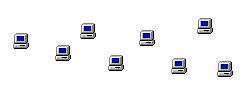
- Then somebody connected some of the computers together in a group. This group was called a network.

- There were Local Area Networks (LANs) that fit in a building.
- There were Wide Area Networks (WANs) that fit in a city.
- Eventually there were lots of separate networks.
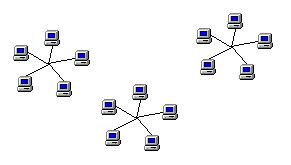
- In addition to all those networks, there were lots of separate computers around too.
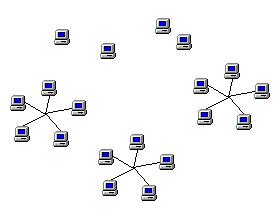
- Then someone said, "Let's network all these networks!" And that made the Internet.
(They even connected some of the individual computers.)
- If you think of a separate computer as a "network of 1", then the Internet is truly a "network of networks".
- All these computers are connected, but none of them is at the center.
- No one person, company, or organization owns the internet.
- No government owns it.
- Everybody just pays for their own individual part.
- Individuals, companies, organizations, and governments, own individual computers, LANs, and WANs, but NOBODY owns the entire Internet.
- If a computer or a LAN or a WAN becomes disconnected somehow, the rest of the Internet continues to function normally.
- Here at the High School, we have a LAN that is connected to the Internet.
- Some day all the computers in all of the High Schools in Leon County, Texas, may have their LANs connected together to form a WAN that will be--you guessed it--connected to the Internet!
- Either now, or some day, you might have a computer in your own home that is connected to the Internet.
- Today, in the United States alone, there are millions of computers that are connected to the Internet.
- And all around the world, still many more computers are connected to this same gigantic "network of networks" called the Internet.
- Computers and their Many Languages
- Just as people in different countries speak different languages--English, German, French, Swahili, Japanese, Russian, Spanish, Greek, and many more--so computers also speak many different languages--Unix, MS-DOS, Windows 95, and "Mac", to name just a few you might have already heard of.
- Ever watch Startrek? Ever wonder how all those aliens seem to speak English? The TV series explains that it's done through a device called a "Universal Translator" that makes you "think" you're hearing English, every Martian "think" he's hearing Martian, and every Vulcan "think" he's hearing Vulcan.
- That's all science fiction. But with computers on the Internet there is such a universal translator. It's called TCP/IP, pronounced by just saying the letters T-C-P-I-P.
- TCP/IP? What's THAT?
- TCP/IP is actually a common networking computer language.
- It stands for Transmission Control Protocol over Internet Protocol.
- TCP/IP sends information across the Internet in groups of information called packets.
- TCP does one job and IP does another
- TCP handles the content and accuracy of each packet.
- IP handles where the packet will go.
- Every computer must have a different IP "address".
- An IP address is just 4 numbers, each of which is somewhere between 0 and 255.